Compare · Zenoo vs RiskNarrative
Keep the LexisNexis data. Change the case.
RiskNarrative is a risk orchestration platform from LexisNexis Risk Solutions. Zenoo orchestrates checks across every provider in Studio, and builds everything around the case: one case per customer with every provider's results on it, an Inbox of what needs a person, and an approval that stays locked until the file is complete.
The short answer
Which one fits your team?
Choose RiskNarrative if
- You want onboarding journeys, decisioning and monitoring from one LexisNexis platform
- Your team wants to write rules in natural language
- Most customers are decided automatically, and people see the referrals
Choose Zenoo if
- Your team's day is the case, not the journey
- You want every provider's results on one case, under your own contracts
- You want approval locked until the file is complete, with every reason on the record
- You want to choose where your data lives: EU, US, or a UK tenant
Side by side
Zenoo and RiskNarrative, row by row.
| RiskNarrative | Zenoo | |
|---|---|---|
| What it is | Orchestration in Studio across every provider you use, and one case per customer in Compliance Hub | |
| Who owns it | LexisNexis Risk Solutions, part of RELX. Founded in Leeds in 2016 as TruNarrative[4] | Zenoo Ltd, independent. Owns no data of its own |
| Screening data | LexisNexis WorldCompliance data through Compliance Lens, with over five million risk profiles[5] | Runs the screening provider you choose, LexisNexis included |
| Other providers | Keep the providers you have under your own contracts, and add others from the Marketplace | |
| Journeys and rules | No-code journeys, with rules written in natural language[1] | Studio builds journeys and workflows across every provider you use, with the case at the centre |
| Case management | Every customer is a case: Inbox, tasks, discussion, files and the full history in one place | |
| Before approval | Not described on its public pages | Approve stays locked while anything on the case is outstanding |
| AI | Machine learning, including a Virtual Agent model that learns from analysts' decisions[1] | Suggests the next step with its sources. A person makes every call |
| Transaction monitoring | Rules-based transaction monitoring[6] | Not built in. Zenoo works alongside your monitoring |
| Where data lives | UK and EEA, on public cloud. The customer cannot choose the location[6] | EU or US region, or a dedicated UK tenant, agreed with you before go-live |
| Security | Declares ISO/IEC 27001[6] | AES-256 at rest, TLS 1.3 in transit. ISO 27001 certification in progress |
What RiskNarrative says about itself comes from its own public pages, numbered in the sources below. Checked 21 October 2026.
Your data comes with you
Keep your providers. Change the case.
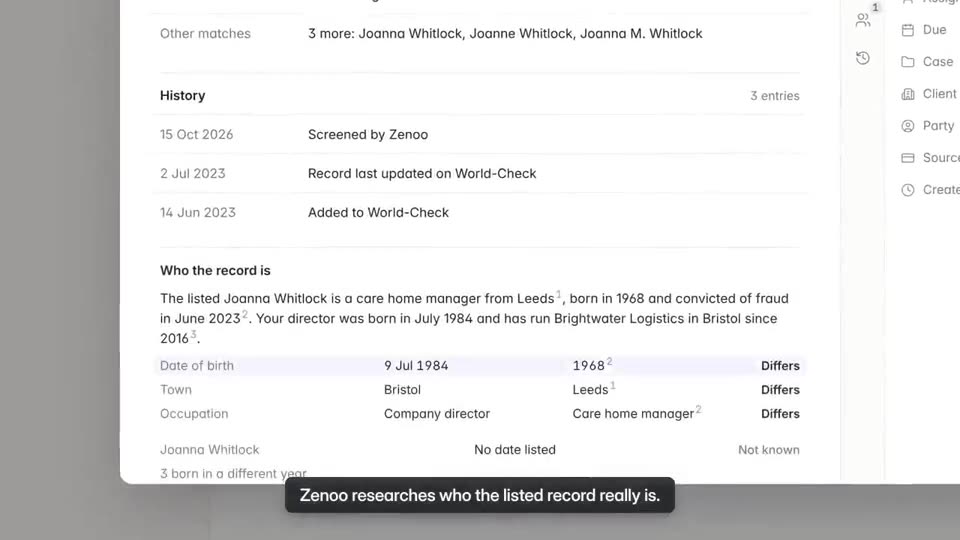
LexisNexis screening, your identity provider and the company registry all send their results to the same case. What needs a person goes to the Inbox, with Zenoo's suggestion and its sources.
Your checksFrom the Marketplace


My inbox0 done
- Screening hitViktor LindqvistDue 11:00
- Identity card is wrongSergei ValtrovToday
Zenoo suggests. You decide.
Switching
How a move works.
See it on a case you bring
A 30 minute demo on one of your own cases, with the providers you use today. Your data. No slides.
Keep your providers
LexisNexis and your other providers connect to Zenoo under your own contracts. Nothing changes between you and them.
Pilot on real cases
Your team works real cases in Zenoo, with us beside you, before anything is switched over.
Go live
Four to six weeks to production is typical, depending on your providers and systems.
Zenoo AI
Zenoo suggests. You decide.
On every case, Zenoo reads what your providers sent back and suggests the next step, with its sources. Nothing is cleared or approved until a person does it, and both are on the record.
To be fair
When RiskNarrative is the better fit.
Questions
Zenoo vs RiskNarrative, asked and answered.
Is Zenoo a RiskNarrative alternative?
For the case your team works, yes. RiskNarrative is a risk orchestration platform that decides automatically where it can and escalates the rest. Zenoo is built around the case: every provider's results for a customer on one record, an Inbox of what needs a person, and an approval that stays locked until the file is complete.
Can we keep our LexisNexis data if we move to Zenoo?
Yes. Keep the providers you use today under your own contracts, LexisNexis included, and add others when you need them.
Does RiskNarrative have case management?
Yes. Its own pages describe referral and case management, and end-to-end case management for alerts, reviews and investigations. The difference with Zenoo is that the case holds every check on the customer, from every provider, with the Inbox, tasks, discussion and full history in one place.
How long does a move take?
Four to six weeks to production is typical, depending on your providers and systems. Your team can pilot on real cases before anything is switched over.
Is RiskNarrative the same as TruNarrative?
Yes. TruNarrative was founded in Leeds in 2016 and acquired by LexisNexis Risk Solutions, part of RELX, in 2021. It is now called RiskNarrative.
Sources
Where the facts come from.
- LexisNexis Risk Solutions, RiskNarrative product page
- LexisNexis Risk Solutions, risk orchestration
- LexisNexis Risk Solutions, RiskNarrative launch press release, 27 June 2023
- LexisNexis Risk Solutions, acquisition of TruNarrative, 25 August 2021
- LexisNexis Risk Solutions, Compliance Lens
- UK G-Cloud 15 listing for LexisNexis RiskNarrative, submitted by LexisNexis Risk Solutions UK Limited
Checked 21 October 2026. Products change: if something here is out of date, tell us at get@zenoo.com and we will correct it. Zenoo product screens on this page show fictional data.








Tomorrow, your case
Bring us a case that went wrong.
We will run it through Zenoo while you watch: the evidence, the decision, and the record your MLRO would want to defend.
30 minutes. Your data. No slides.